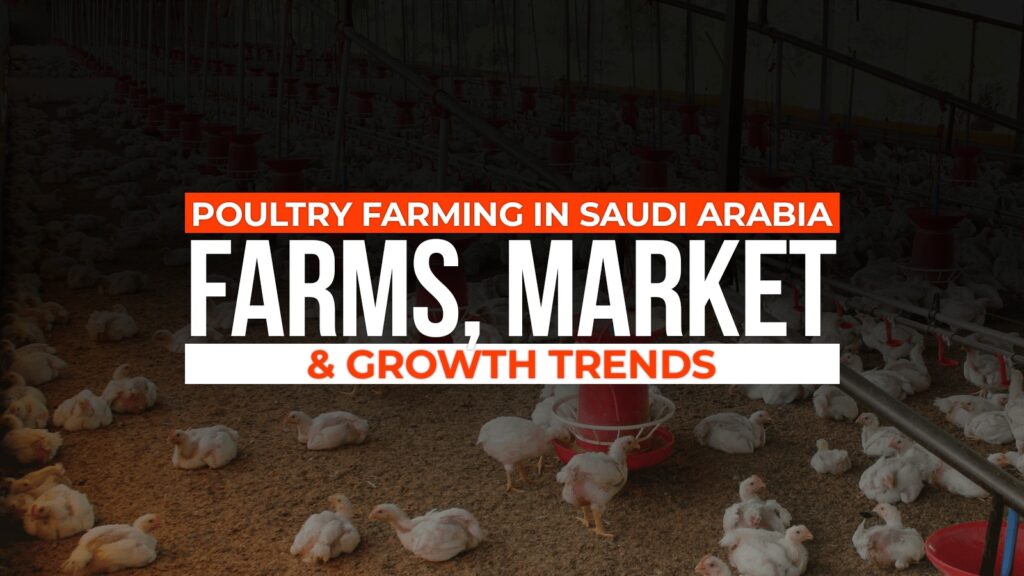
The Saudi Arabian poultry farming industry is noted in this context to be one of the fastest-growing industries within the country. The increase in demand for sources of proteins, coupled with friendly government policy, has ensured that poultry plays an important role in the efforts to achieve the goal of food security in the country. All across the Kingdom of Saudi Arabia, from family farms to large commercial operations, poultry farming has undergone great modernization in the last decades.
Today, with a growing population and increasing awareness in nutrition and healthy eating, poultry has become one of the staples in the households of Saudis. Demand keeps on increasing, both for chicken meat and eggs, and poultry has become one of the highly promising agricultural ventures in the country. Its growth does not stop at production but expands further into processing, distribution, and retail, creating a full-fledged poultry ecosystem that adds its value to the economy as a whole.
Improvement has also been witnessed in farm management within the Saudi poultry sector, with several modern poultry farming companies in Saudi Arabia emerging in Saudi Arabia. This not only helps to meet the demand arising from an increasing market but is accomplished through continuous innovation in feed management, disease control, and efficiency in farms. Hence, any investor who intends to enter this sector has to comprehend the basics of the Saudi poultry industry and the dynamics propelling growth therein.
Poultry Farm Setup in Saudi Arabia
The poultry farm in Saudi Arabia must be well-planned and comply with all the regulations in Saudi Arabia. The basic determinants of a successful farm include farm location, water accessibility, feed supply, and market proximity. Typically, farms raise either broilers for their meat or layers to sell their eggs; most instances have one or the other, but some have both. Because of the extreme desert climate with varying temperatures in different seasons, a controlled environment must be created.
Climate-controlled housing in modern farms protects birds from heat, dust, and diseases by regulating ventilation and humidity levels. Animals require quality feed and clean water, as well as proper management procedures followed carefully at poultry farms. In return, this will serve as an investment towards healthier flocks with increased productivity and reduced mortality.
The broiler farms try to raise poultry quickly and efficiently for meat, having optimum nutritional intake that would best enhance growth rates by means of proper lighting schedules and temperature regulation. On the other hand, the laying farms focus on continuous egg production, utilizing appropriate nutrition, lighting, and stress management to maintain quality and quantity.
Demand and Market Trends
This growth has been very steady in Saudi Arabia, considering population increases and changes in dietary habits. Chicken meat and eggs stand today among the most consumed protein types in the country. Driven by this demand, recent growth has taken place in the increase in farm size, investment in technology, and the development of large-scale companies in poultry farming in Saudi Arabia.
Other important contributing factors to the expansion of poultry production in Saudi Arabia are government support. Subsidies on feed and veterinary support, and incentives for adoption of modern technology, have made poultry farming more profitable and sustainable. The emphasis on self-reliance and food security makes locally produced poultry compete with imported products at a very reasonable price for the consumer.
Increasingly, consumers are becoming more aware of food safety and quality, which in turn raises the demand that farms use a higher standard of welfare for animals. Therefore, farms that can sustain higher levels of production and biosecurity stand a better chance of gaining consumer trust and securing long-term market share.
Developments in Technology and Modern Practices
Modern management techniques in poultry farming in Saudi Arabia have enhanced efficiency and productivity. Fully automated feeding systems, environmental monitoring, and precision farming technologies enable farmers to know in real time feed conversion ratios, growth rates, and the health of their flocks.
The climate control systems ensure temperature and humidity controls, which are fundamental to broilers and layers, particularly during very hot summer months. Automated feeders, water lines, and lighting systems minimize labour costs while promoting the comfort of birds, which is directly related to their growth and production.
Another important constituent in modern poultry farm management is biosecurity. Farms restrict access of outsiders, regularly disinfect equipment, and follow strict veterinary protocols. In such a way, outbreaks of diseases are avoided, since they can destroy the flocks and bring considerable financial losses.
Attention has also shifted to sustainability, where farms are considering renewable energy investments, water recycling systems, and manure management systems. This means that chicken farming in Saudi Arabia is not only profitable but also environmentally responsible and in line with global trends in sustainable agriculture.
Challenges and Opportunities
While the Saudi poultry industry has rapidly expanded, some major challenges still lie ahead. Among those are very high feed costs, water scarcity, and required levels of skilled labor. Extreme climates can also stress the birds, which again may raise problems regarding productivity and health.
All these challenges bring opportunities, too. Innovations in feed efficiency, water conservation, and employee training will give farms an advantage. Companies investing in technology and sustainable practices can reduce operational costs while meeting consumer demand for safe, high-quality poultry products.
Niche opportunities for specialized farms come from the increasing demand for organic and free-range poultry. Investors can focus on animal welfare, traceability, and premium product offerings to help meet the consumer expectation and command higher prices for their offerings.
Future Prospects for Poultry Farming in Saudi Arabia
Prospects for poultry farming in Saudi Arabia are very bright. Continuous government support, along with the integration of technology and demand by consumers, will further spur growth. It is envisioned that expansion both in broiler farming in Saudi Arabia and layer firms will increase production in poultry meats and improve the availability of eggs in egg production in Saudi Arabia.
As farms become more modern and move toward precision farming and sustainability, productivity and efficiency will also grow. Further growth will create job opportunities, allied industries for feed production and logistics, and strengthen the overall agricultural sector in the Kingdom.
All in all, investors perceive that the Saudi poultry market can offer something quite rare: stability and profitability. Appreciation of the dynamics of poultry farming companies in Saudi Arabia is best achieved by implementing best practices that allow farms to realize long-term success and contribute toward the achievement of national food security.
Conclusion
Poultry farming is currently one of the thriving and lucrative businesses in Saudi Arabia. Small and large-scale operations can equally be very rewarding with careful planning, adoption of modern poultry farm management practices, and response to market trends. However, the success of this business needs familiarity with the Saudi poultry industry in aspects like broiler and layer management, feed and water strategies, climate control; and biosecurity. General poultry solutions for professional advice are targeted to optimize operations for efficiency and sustainable growth. The poultry sector in the Kingdom is not only a business venture but also a contribution to food security. It is those farms that will lead the future in Saudi Arabian poultry production that can combine innovation, sustainability, and effective management, strengthening poultry meat production in Saudi Arabia.